
An API gives software a defined way to interact with another system. MDN describes it as a set of features and rules that enables this interaction. For a travel business, the useful question is which parts of the supplier workflow the proposed connection supports.
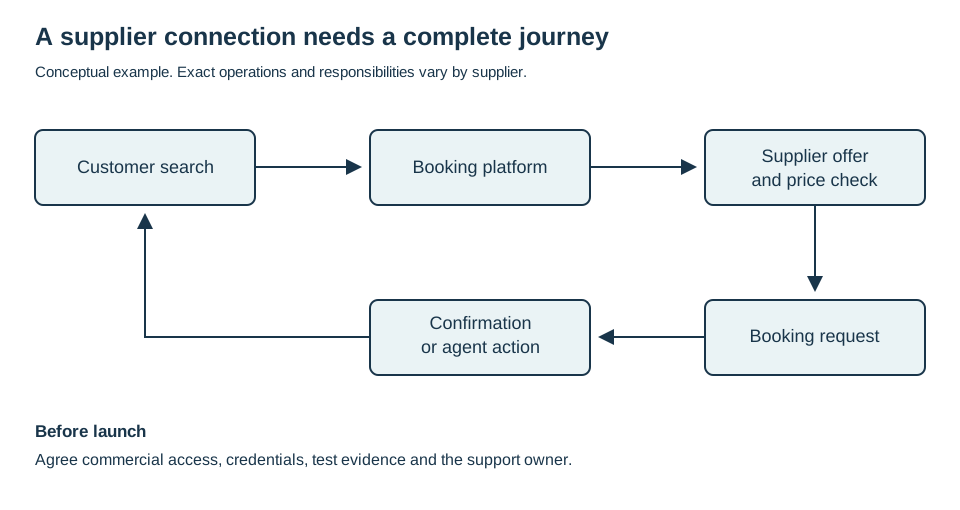
Start with a journey you need to operate: search, compare, price check, book and manage the result. Ask the integration provider to show those steps with the supplier documentation alongside them. This gives you something concrete to evaluate beyond a general promise of connected systems.
Map the supported operations
List the actions your team needs and identify the documented operation for each. Include retrieving an existing booking and handling an unresolved outcome. Your review should cover the work after the first successful sale too.
Expedia Rapid's Booking API, for example, books rooms and rates confirmed through its Price Check response. That is a documented sequence for that service. Check each supplier's process separately rather than assuming that all APIs behave identically.
Ask which information is returned at each step and when it must be checked again. Record any gaps or manual handovers. This gives the team a clear view of what the integration supports without assuming that every connected field is always current.
Check the account and credentials
Confirm which supplier account and environment the connection uses. Stripe's key documentation illustrates why key types matter: publishable and secret keys have different purposes. Test keys are also separate from live operation. Apply the relevant provider's own rules.
Keep secret values in the approved secure system. Record their owner and purpose in the project notes without copying the credentials themselves. This preserves a useful handover while limiting unnecessary exposure.
Before enabling real transactions, ask for evidence that the intended environment and account were tested. Include any supplier approval or activation step that applies to the particular integration. Give each outstanding action an owner before agreeing the launch date.
Separate technical readiness from commercial access
A platform can maintain a supplier connection while your agency still has access requirements to complete. Ask whose supplier account will be used and which commercial arrangements apply to your bookings. Our supplier connectivity page explains that some suppliers need their own agreement or API credentials during onboarding.
Hotelbeds' getting-started documentation describes evaluation credentials and testing before production use. Its hotel certification process separates those tests from live bookings with real commercial consequences. If you use an established platform, agree which technical steps it has already completed and which actions remain specific to your agency.
An aggregator can also put several suppliers behind one connection. intuitive's iVectorOne describes this approach for accommodation, including direct contracts and bedbanks, with hotel content mapping. That changes the integration work, but your team still needs to compare room details and conditions when the same property is returned through different sources.
Write the remaining onboarding actions into a short record with an owner and the evidence needed to close each one. Keep credentials themselves in the approved secure system, rather than in that record. Use the supplier API flow diagram as a conceptual aid, then confirm the operations your own supplier supports. A supplier should enter your launch plan when you understand the account, supported operations and route for booking problems.
Read the booking outcome behind the response
HTTP status codes describe request outcomes at the protocol level. MDN groups them into informational, success, redirect, client-error and server-error classes. The application response still needs to be interpreted using the supplier's documentation.
Agree which returned information proves a booking is confirmed, which means it is pending and which requires investigation. Test the customer-facing message against those states. This helps your team avoid turning an integration status into an unsupported promise to the traveller.
Use fictional or supplier-approved test bookings. Include unavailable inventory and an uncertain response as well as the successful case. Ask a colleague to explain the action they would take for each result.
Plan for an interrupted request
Stripe's error-handling guidance explains that a connection failure can leave it unclear whether a request was received or executed. Reconnecting doesn't settle that question. Its documented retry and reconciliation rules are specific to its API.
Ask your travel supplier how to recover from an ambiguous booking request. Record how the existing outcome is checked before another write is attempted and what support route applies. Don't assume that repeating a request is harmless.
Where the provider supports idempotency, have the technical team explain its scope and limits for the operation. Test the documented process with the provider. Your team should understand both the normal response and the recovery path before relying on it.
Make support evidence useful
Keep the operation, timestamp, environment, status and request identifier in an approved diagnostic record. Stripe recommends providing its request ID when asking about a specific request. Use the equivalent identifier supplied by the service you're investigating.
Separate that technical identifier from the booking reference. Share redacted evidence through the agreed support channel. Include enough to locate the exchange without exposing credentials or unnecessary traveller details.
Our glossary explains API keys, HTTP status codes and request IDs. Use those definitions when agreeing the information your team will record. The guide to why live travel prices can change can help you prepare the changed-offer test.
Agree a measurable acceptance check
Finish the review with a short list of demonstrated tasks and unresolved gaps. Identify who owns each gap and what evidence will close it. Ask the people who will handle bookings to work through any unresolved recovery step before approving the connection.
Assess any claimed saving or improvement against your own observed workflow after implementation. An API connection alone doesn't establish a particular reduction in work, a better fare or a business result. Choose a task you can observe and record how your team handles it once the new connection is running.
Explore the Travelgenix platform
See how the platform helps travel businesses sell more online, from award-winning websites and booking tools to AI marketing.