
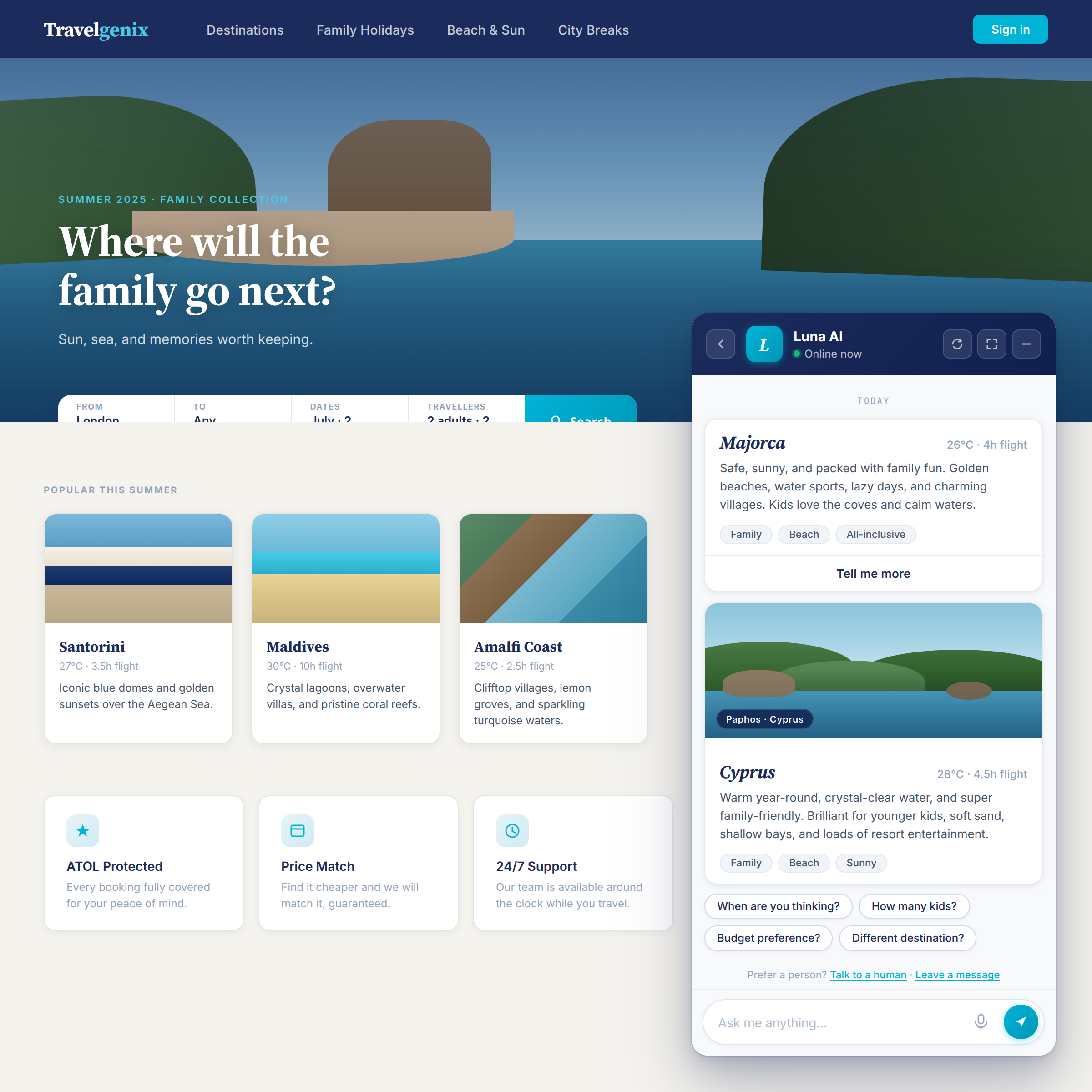
Luna Chat is AI live chat built for travel. It answers questions, searches live prices and books holidays without the visitor leaving the chat window.

Your clients still want to go on holiday. That much hasn’t changed. What has changed is the map they’re working with, and right now a significant chunk of it is off limits. The ongoing conflict across the Middle East has closed airspace, grounded flights and triggered FCDO warnings against all but essential travel to destinations including the UAE, Qatar, Bahrain and Kuwait. British Airways has suspended routes to Dubai, Doha and Abu Dhabi until at least June 2026, and the knock-on effects stretch far beyond the Gulf itself. For travel agents, this creates a challenge and an opportunity in equal measure. Oxford Economics estimates the Middle East could lose up to $56 billion in tourism revenue this year, with international arrivals dropping by as much as 27%. The World Travel and Tourism Council puts the daily cost of the disruption at roughly $600 million. Those are enormous numbers, but they also represent millions of travellers actively looking for somewhere else to go. Your job is to be the person who shows them where. The routing problem you need to understand Before we get into destinations, it’s worth spelling out what the Middle East disruption actually means for flight planning. It isn’t just about cancelling a Dubai beach holiday. Dubai, Doha and Abu Dhabi are three of the world’s busiest transit hubs, handling around 14% of all international connecting traffic. If your client was flying to Thailand, the Maldives, Bali, Australia or South Africa via Emirates, Qatar Airways or Etihad, that route is currently broken. The good news is that airlines are adapting fast. British Airways has added extra capacity on direct flights to Bangkok and Singapore from Heathrow. Lufthansa is preparing new services to Kuala Lumpur, and Virgin Atlantic is launching daily flights to Seoul. For short-haul travel, European carriers have increased frequencies to Spain, Portugal, Italy and Greece to absorb redirected demand. Ryanair CEO Michael O’Leary confirmed a surge in short-haul bookings, calling it a direct consequence of collapsed confidence in Gulf travel. The message for agents is simple. Think about how your client gets there, not just where they’re going. Every recommendation in this article can be reached on direct UK flights or via non-Middle East hubs like Istanbul, Johannesburg or Singapore. Short-haul sun that genuinely delivers For clients who were planning a week of warmth, pool time and five-star service in Dubai or Oman, Europe has more to offer than they might think. The trick is matching the experience, not just the climate. Greece is the standout. Crete’s south coast has a genuine desert-island feel, with pink sand at Elafonissi and turquoise lagoons at Balos that rival anything in the Indian Ocean. Santorini and Mykonos deliver the luxury boutique experience, while Rhodes and Kos offer incredible value for families. Flight times from the UK sit between three and four hours, and availability this spring is strong. Southern Spain’s Costa del Sol is seeing a significant booking surge from redirected Gulf travellers. Marbella’s five-star resort scene, from the Puente Romano to the new Finca Cortesin beach club, gives clients a genuine luxury experience with year-round sunshine and direct flights from most UK regional airports. For something quieter, Portugal’s Algarve continues to punch above its weight, with world-class golf, dramatic coastal scenery and a food scene that keeps getting better. Turkey deserves special attention. The FCDO is not currently advising against travel to Turkey’s main resort areas, and Antalya, Bodrum and Fethiye are operating completely as normal. Turkish Airlines flights from the UK to Turkish resorts are unaffected, and the combination of all-inclusive luxury, ancient ruins and stunning coastline makes this a compelling swap for clients who wanted that blend of culture and relaxation. The Canary Islands round out the short-haul picture. Tenerife, Lanzarote and Gran Canaria offer guaranteed warmth year-round, a huge range of accommodation from budget aparthotels to high-end spa resorts, and flight times of around four hours. For the client who simply wanted sunshine and zero stress, this is the easiest sell on the list. Long-haul without the Gulf layover This is where your expertise really earns its keep. Plenty of clients will assume that long-haul travel is simply off the table right now. It isn’t. They just need a different route. The Caribbean is the most natural swap for the luxury beach client who was heading to the Gulf. Barbados, St Lucia and Antigua all have direct flights from London, with flight times of around eight to nine hours. St Lucia’s Piton mountains, luxury boutique resorts and marine reserves give it a genuine wow factor that matches anything in the Arabian Gulf. Antigua offers 365 beaches and a more relaxed, barefoot-luxury vibe. Barbados brings world-class dining, surf culture and the kind of consistent winter sun that your clients are craving. For the all-inclusive crowd, Mexico’s Riviera Maya is another strong play, with direct flights from Gatwick and Manchester and a huge range of resort options. Thailand is back in a big way. British Airways has specifically increased capacity on its London to Bangkok route to capture demand from travellers who would normally connect through the Gulf. A direct flight from Heathrow takes around 11 hours, and from Bangkok your clients can connect easily to Phuket, Koh Samui or Chiang Mai. Thailand offers everything from budget backpacking to ultra-luxury pool villas, and the exchange rate remains incredibly favourable for UK travellers. The Maldives is still reachable, but the routing needs care. Most UK visitors previously flew via Dubai or Doha, and those connections are gone for now. The alternative is to fly via Colombo on Sri Lankan Airlines, or to connect through Singapore or Kuala Lumpur. It adds time, but for clients set on that overwater villa experience, the Maldives remains open and welcoming. Agents who can confidently route around the disruption will win serious loyalty here. Mauritius is an often-overlooked gem that deserves a much bigger spotlight right now. Air Mauritius operates direct flights from Heathrow, and the island delivers a similar experience to the Maldives at a lower price point. Think white sand beaches, world-class snorkelling, luxury resorts with overwater options and a rich Creole food culture. For couples and honeymooners who were eyeing the Gulf’s beach resort scene, Mauritius is a brilliant alternative. South Africa is worth raising for the adventure-seeking client. It’s true that around 25% to 30% of South Africa’s inbound tourism typically transits through Middle East hubs, so capacity is tighter than usual. But British Airways and Virgin Atlantic both fly direct from Heathrow to Johannesburg and Cape Town. A two-week Cape Town and safari combination gives your clients a holiday they’ll talk about for years, and it sidesteps the Gulf entirely. This is the moment travel agents prove their worth Here’s the thing about disruption. When everything runs smoothly, clients can book their own holidays on a comparison site and feel perfectly clever about it. When the map changes overnight, when transit hubs close and flight routes collapse, when FCDO warnings stack up and insurance policies start excluding entire regions, that’s when they need someone who actually knows what they’re doing. That someone is you. The travel agents and tour operators who move quickly right now, who update their websites with alternative destination content, who pick up the phone and proactively call clients with rebooking options, are the ones who will come out of this period with stronger relationships and fuller pipelines. Your clients don’t want to be told that their holiday is cancelled. They want to be told where they’re going instead. The Middle East will recover. It always does. But between now and then, the rest of the world is very much open for business, and your clients are waiting for you to show them the way.

Three weeks ago, the Middle East was the fastest-recovering tourism region on the planet. Dubai had just closed 2025 with a record 19.59 million international overnight visitors. Hamad International Airport in Doha was up 3% year on year. The region had welcomed roughly 100 million tourists in 2025, sitting 39% above pre-pandemic levels according to UN Tourism. Every indicator pointed to another record-breaking year. Then, on 28 February 2026, the US and Israel launched coordinated strikes on Iran. Within 48 hours, more than 5,000 flights were cancelled. Airspace across the UAE, Qatar, Bahrain, Jordan, Iraq and Israel was either closed or severely restricted. The FCDO issued warnings against all but essential travel to a string of countries that, only days earlier, had been selling Easter sun packages to British holidaymakers. If you run a travel business in the UK, you've felt the shockwave already. Cancelled bookings, anxious clients, disrupted itineraries, refund requests. It's been relentless. But here's what I want to talk about: what happens next. Because if the last 25 years of global travel have taught us anything, it's that demand doesn't disappear during a crisis. It moves sideways, it builds pressure, and then it comes roaring back. The scale of the disruption is staggering, but it's not permanent The numbers coming out of the Middle East right now are genuinely sobering. The World Travel and Tourism Council estimates the region is losing around $600 million per day in international visitor spending. Aviation analytics firm Cirium reports that more than 46,000 flights have been cancelled since the conflict began. Oxford Economics, in its most recent modelling, projects that inbound arrivals to the Middle East could fall by between 11% and 27% year on year in 2026, depending on how long hostilities continue. In real terms, that's somewhere between 23 and 38 million fewer visitors, and a potential loss of $34 billion to $56 billion in visitor spend. For UK agents, the practical fallout has been immediate. British Airways has suspended flights to Dubai, Bahrain, Tel Aviv and Amman through at least May 2026. ABTA has confirmed that its members will not be sending customers to the region while FCDO advice remains in place. The travel insurance picture is complicated too, with many standard policies excluding war-related disruption, leaving agents fielding difficult conversations with clients who assumed they were covered. None of this is easy. But it's worth pausing to recognise that the Middle East's role as a global transit hub is what makes this crisis feel so far-reaching. The region's airports handle around 14% of all international transit traffic, connecting Europe to Asia, Australasia and parts of Africa. When those hubs go quiet, the ripple effects touch routes and destinations that have nothing to do with the conflict itself. That's why you're seeing slowdowns in bookings to the Maldives, Thailand and even parts of the Eastern Mediterranean. Clients aren't just worried about flying to the Middle East. They're worried about flying through it. History shows us a clear and consistent pattern I've been in travel long enough to remember the gut-punch of 9/11. The US grounded its entire commercial fleet for three days. In September 2001, air travel volumes dropped 31.6% compared to the same month the previous year, according to the Bureau of Transportation Statistics. Airlines haemorrhaged cash. Over 62,000 airline jobs were cut in the weeks that followed. It took nearly three years for US passenger numbers to return to pre-attack levels, and about five years for average airfares to recover. The entire industry went through a period of consolidation, cost-cutting and reinvention. Then came the Iraq war in 2003. The WTTC projected that a prolonged conflict would destroy more than three million travel and tourism jobs globally and wipe out over $30 billion in economic value. Bookings fell across the board. Cruise lines slashed prices. Theme parks froze hiring. Florida saw one million fewer visitors in the year following the first Gulf War. But the recovery came, and it came faster than many predicted, particularly for businesses that had used the downturn to sharpen their offer and stay visible to customers. COVID was, of course, the most extreme version of this pattern. UK outbound travel effectively dropped to zero. But when restrictions lifted, the pent-up demand was extraordinary. ONS data shows that UK residents made 71 million overseas visits in 2022, up 272% from just 19.1 million the year before. The "revenge travel" phenomenon wasn't a marketing buzzword. It was a measurable, explosive release of deferred spending and deferred desire to experience the world. At its peak in 2022 and 2023, European airports saw passenger volumes surge by as much as 250% according to ACI Europe data. The lesson from every single one of these events is the same. People want to travel. When something stops them, the desire doesn't fade. It accumulates. And when confidence returns, it releases with a force that consistently catches the industry off guard. The demand is already moving, not vanishing Here's the bit that matters most for your business right now. Travellers aren't cancelling holidays altogether. They're redirecting them. The data on this is already clear, even three weeks into the crisis. TUI UK has confirmed a rise in demand for Spain, Portugal, Greece and Cape Verde. Kuoni reported an 18% increase in Africa bookings in a single week. TravelSupermarket saw searches for Cape Verde more than double in early March compared to the 11 days before that. Cirium's forward booking analysis for April 2026 shows that Australia-to-Europe bookings, excluding Middle Eastern transit hubs, have surged by 48.6% since late February. Across the board, the pattern is consistent: travellers with disrupted plans are pivoting to alternatives rather than staying home. For UK SME travel agents, this is where the opportunity sits. Your clients still want to go somewhere. Many of them had a budget allocated, time booked off work and a mindset geared towards a holiday. What they need now is a knowledgeable person who can help them find a brilliant alternative quickly, with confidence and without the stress of figuring it out alone. That person should be you. Not a comparison site. Not a chatbot. You. The agents I've spoken to over the past fortnight who are doing well right now are the ones who picked up the phone before their clients did. They contacted customers with affected bookings proactively. They had alternative options ready to present. They didn't wait for the panicked call at 9pm on a Sunday. They led the conversation, and in doing so, they reinforced exactly why booking with a real agent matters. Small travel businesses can be faster and smarter than the big players One of the things that frustrates me about crisis commentary in our industry is the assumption that small businesses are the most vulnerable. In my experience, the opposite is often true. A large tour operator with thousands of pre-committed seats in the Gulf takes months to reposition capacity. An SME travel agent with a good supplier network and a personal relationship with 200 clients can pivot in a day. Your size is your advantage here. You can message your clients directly, with their names, their preferences, their travel history in mind. You can recommend a specific resort in the Algarve because you know they loved that quiet boutique hotel in Ras Al Khaimah and you've found something with a similar feel. You can make the switch feel like an upgrade rather than a compromise. That's something no OTA algorithm can do, and it's exactly what builds the kind of loyalty that keeps clients coming back for years. Oxford Economics' David Goodger made an important point in a recent webinar when he noted that recovery timelines after crises have been getting shorter over time. Travellers are more resilient than they were 20 years ago. Booking windows are shorter. People are more comfortable making last-minute decisions. For a nimble, well-prepared travel business, that shorter bounce-back window is a genuine competitive advantage, because you can respond to returning demand faster than the big operators can spin up their machinery. Five things you can do right now to prepare for the rebound Whether the current conflict lasts weeks or months, the rebound will come. Here's how to make sure you're ready to capture it. Audit your supplier mix and fill any gaps in short-haul and alternative long-haul product: If your portfolio is heavily weighted towards the Middle East or destinations that transit through Gulf hubs, now is the time to broaden it. Look at what's selling right now: Western Mediterranean, Cape Verde, the Caribbean, East Africa. Make sure you have competitive product and pricing in the destinations where demand is flowing today. Contact every client with an affected booking before they contact you: Proactive communication is the single biggest trust builder in a crisis. Even if you don't have all the answers yet, a message that says "I'm aware of the situation, I'm looking at options for you, and I'll be in touch within 48 hours" is worth more than silence followed by a reactive scramble. Build a "rebound ready" marketing list and start warming it now: Identify every client who cancelled or deferred a trip due to the Middle East situation. Keep them engaged with content, destination ideas and early-access offers. When the FCDO lifts its warnings and flights resume, these clients will be your fastest converters. The agencies that already have a relationship with them will win the rebooking. Create content around alternative destinations while attention is high: Your website and social channels should be talking about where people can go right now, not just echoing the bad news. A blog post titled "10 Sunny Alternatives to Dubai This Spring" or "Why Croatia Could Be Your Best Holiday Decision This Year" positions you as a helpful guide rather than a passive bystander. Review your cancellation and refund workflows so you're not drowning in admin when volume picks up: Crises generate admin. Refund requests, rebookings, insurance queries, supplier credits. If your processes are manual and inconsistent, you'll spend the next three months buried in paperwork instead of selling. Tighten your workflows now so that when the recovery wave hits, your team is free to focus on revenue, not reconciliation. Tourism Economics' latest modelling suggests that even under a two-month conflict scenario, the recovery tail would last around nine months, with disrupted arrivals and softer sentiment stretching through the rest of 2026. That sounds daunting. But it also means the agencies that start positioning themselves now, building alternative product knowledge, strengthening client relationships and creating visible, helpful content, will be the ones that capture the wave when it arrives. Travel has survived 9/11, two Gulf wars, a global financial crisis and the worst pandemic in a century. It came back every single time, often stronger and more resilient than before. The fundamental human desire to see new places, experience different cultures and make memories with the people you love doesn't switch off because the news is bad. It just waits. And when the waiting ends, the people who booked first were the ones with a trusted agent who was already thinking ahead. Be that agent.
